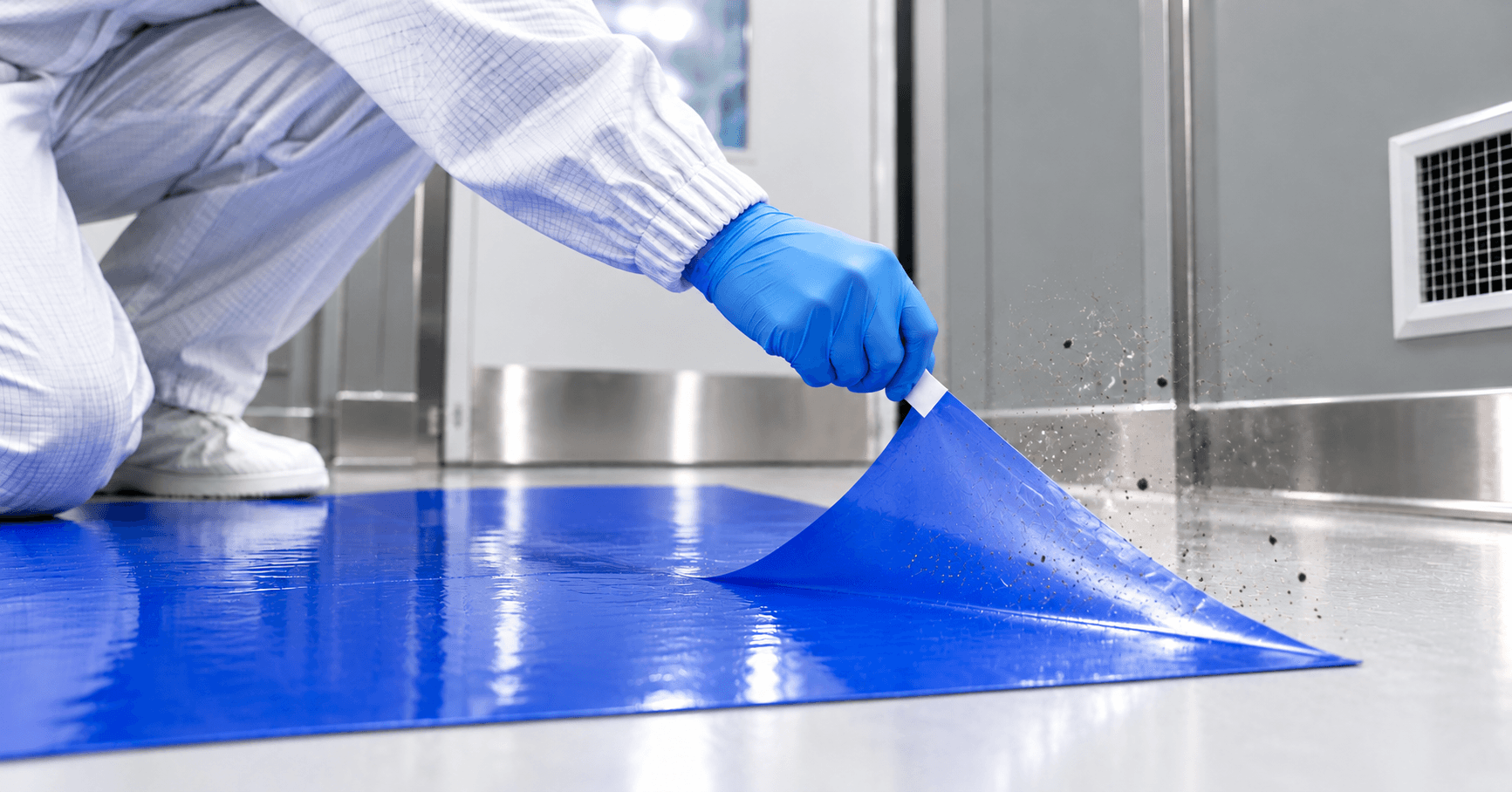
Most discussions about tacky mats focus on what they capture. Few look at what happens when a loaded sheet comes off. Yet the sheet change is a hands-on task repeated as often as traffic demands, performed at the exact point a contamination control strategy exists to protect: the cleanroom entrance.
Below, a sheet change is broken into its individual movements to show where static and airborne particles originate.
Tacky Mats vs Reusable Cleanroom Matting: What Happens at Changeover
1. Routine Maintenance
Tacky (Sticky) Mats: Peel and discard the particle-loaded top sheet.
Polymeric Mats: Clean the surface in place without removing any layers.
2. Mechanical Action at the Threshold
Tacky (Sticky) Mats: Peeling, folding and rolling particle-loaded adhesive film.
Polymeric Mats: Wiping a fixed surface without disturbing or removing layers.
3. Static During Maintenance
Tacky (Sticky) Mats: Adhesive-film separation can generate electrostatic charges.
Polymeric Mats: CC Matting material is tested within the static-dissipative range.
4. Waste Generation
Tacky (Sticky) Mats: Used adhesive sheets generate recurring single-use waste.
Polymeric Mats: CC Matting offers a 3–5 year service life, as stated in its technical data sheet.
5. Particle Emission Evidence
Tacky (Sticky) Mats: Particle emission varies by product; supplier test data should be requested.
Polymeric Mats: CC Matting material is qualified by Fraunhofer IPA as suitable for ISO Class 5 under mechanical stress.
Anatomy of a Sheet Change: Four Moments That Release Particles
1. Lifting the corner
The operator kneels at the threshold and grips a corner tab, bringing gown and gloves to floor level. The glove touches the most heavily loaded zone of the sheet.
2. The peel
When an adhesive separates from a film, the two surfaces exchange electrical charge, an effect known as triboelectric or peel charging. The release is also mechanical: stored elastic energy snaps through the sheet, which can dislodge loosely held material such as particles resting on earlier debris, weakly bonded fibres and fragments of adhesive at the peel front.
3. Folding and rolling
Rolling traps much debris adhesive-to-adhesive, but the sheet flexes repeatedly and the outer turns stay exposed. Each touch while carrying the bundle away is a transfer opportunity to gloves and sleeves.
4. The newly exposed layer
The fresh sheet has just been separated from the layer above, so it can carry residual charge of its own. A charged surface attracts airborne particles, which means the "clean" layer may begin its service collecting what the peel has just released.
Why Static at the Threshold Matters
Charge on an insulating film does not drain away quickly. In semiconductor and data centre environments, that adds an electrostatic discharge consideration. In pharmaceutical and healthcare settings, charged surfaces and garments attract and hold particles.
The size of the effect depends on adhesive, film, peel speed and humidity, so assess it on site rather than assume it.
The Location Problem: Disposal Happens at the Interface
Entrance mats sit at controlled/uncontrolled zone interfaces, beside doors and airlocks where door openings already disturb air at floor level. A particle-generating task there compounds risk at the most exposed point.
EU GMP Annex 1 (2022) expects sterile manufacturers to maintain a documented contamination control strategy. Entrance matting, and how it is maintained, belongs in that assessment. No mat on its own guarantees compliance.
If You Still Use Tacky Mats: Reducing Changeover Risk
• Schedule sheet changes outside peak traffic and away from door-opening cycles.
• Peel slowly and steadily, folding the loaded face inwards first.
• Bag the used sheet at the mat rather than carrying it through the area.
• Change or sanitise gloves immediately afterwards.
Washable Cleanroom Mats: The Sticky Mat Alternative That Removes the Peel
Washable contamination control mats change the maintenance task itself. A polymeric surface is cleaned where it lies, so there is no sheet to peel, roll or carry out. That specific difference is what makes contamination control polymeric matting a practical tacky mat alternative at the threshold.
For CC Matting, Fraunhofer IPA issued a qualification certificate (report CC 2603-1736) confirming particle emission under tribological stress within ISO 14644-1 Class 5 limits. Independent surface resistivity testing placed samples in the static-dissipative range.
In a walk-off study by CPC Laboratories, three steps on the mat removed on average 91.8% of particles above 5 µm, 100% above 100 µm and 92.0% of fibres from shoe soles. Trolley wheels rolled over 90 cm saw 90.1%, 100% and 100% respectively. The laboratory notes these results apply to its test conditions, not every application.
A reusable approach still needs a defined cleaning procedure. Footwear contamination control works best as one step alongside gowning, airflow and wheel management.
Frequently Asked Questions
Do tacky mats release particles when they are peeled?
They can. Peeling releases stored mechanical energy that can dislodge loosely held particles, fibres and adhesive fragments. The amount varies with product, technique and sheet loading.
Why do sticky mats generate static electricity?
Separating adhesive from film transfers charge between the surfaces (triboelectric charging). Insulating films hold it, so both the used sheet and the new layer can attract airborne particles.
How often should tacky mat sheets be changed in a cleanroom?
Set frequency by traffic and site risk assessment. More frequent changes maintain capture but also multiply peel events at the entrance, a trade-off worth recording in your contamination control strategy.
Are polymeric contamination control mats suitable for ISO Class 5 areas?
It depends on the product, so ask for independent data. CC Matting’s material holds a Fraunhofer IPA qualification as suitable for ISO Class 5, based on particle emission testing under mechanical stress.
What should I ask a contamination control mat supplier?
Ask for independent particle-removal and particle-emission data, surface resistivity results, cleaning instructions and expected service life, and check the test conditions behind each result.
Next Step
Start by mapping where and how often sheets are peeled at your entrances. From there, review the reusable contamination control matting specification, the test evidence on the compliance page, or discuss your entrance layout. CC Matting installs in Ireland and the UK and distributes worldwide.
