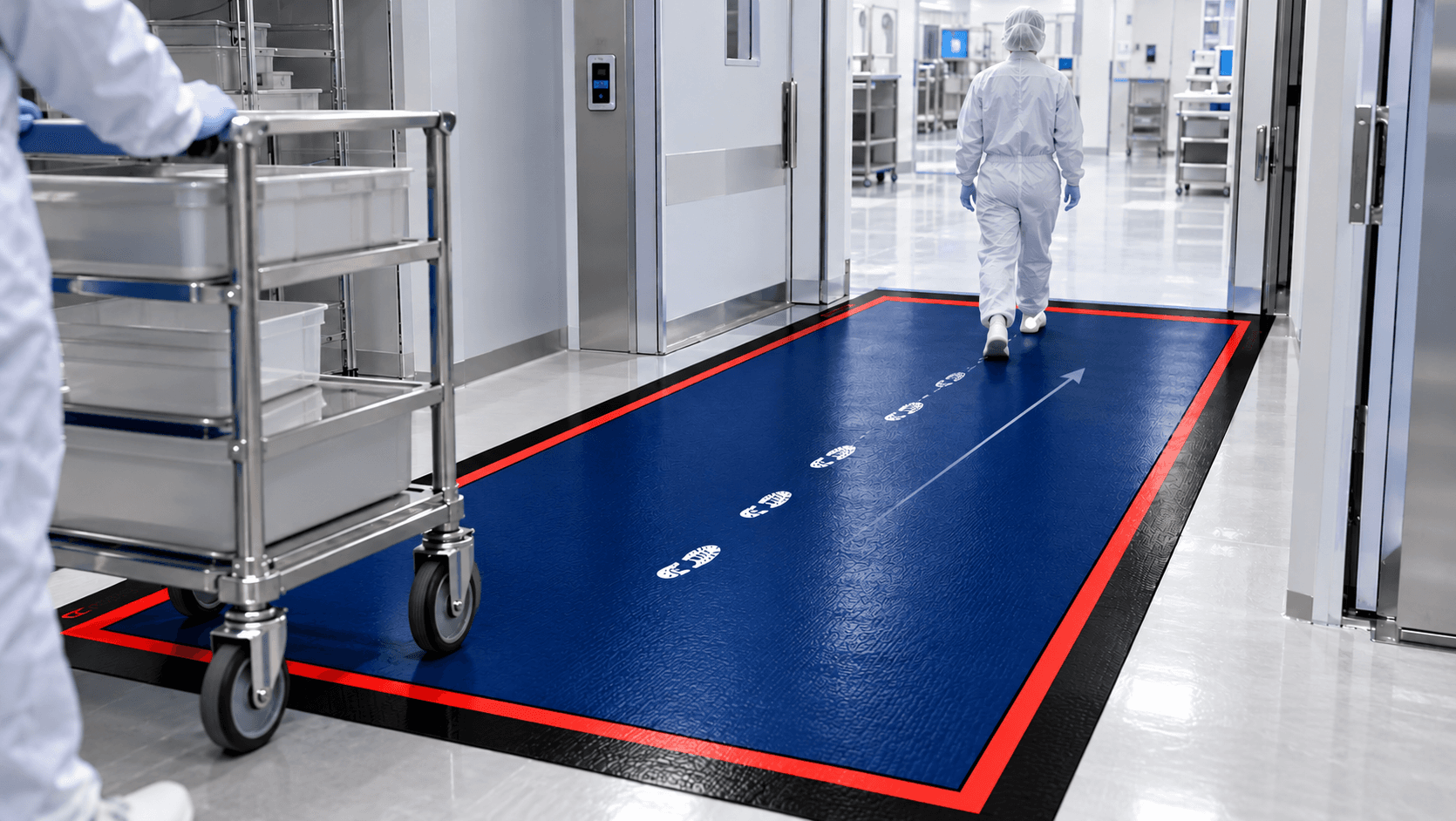
Most cleanroom entrance mats are sized to the door. But contamination transfer happens in the direction of travel, one contact at a time, so the better question is how many times each sole or wheel touches the mat.
Where “six steps” comes from
Six steps means three contacts per foot, the condition under which walk-off efficacy is commonly tested for contamination control mats.
In a February 2026 study for CC Matting, CPC Laboratories Inc. loaded rubber-soled shoes with warehouse floor dirt, then stepped three times on the polymeric mat with one shoe. Average removal was 91.8% for particles above 5 µm, 92.0% for fibres above 100 µm and 100% for particles above 100 µm. Results apply only to the tested materials and method.
The sizing implication is direct: a mat that gives each foot one contact sits outside the tested condition, and those figures should not be assumed for it.
Stride length sets the minimum length of contamination control matting
A step runs from one foot to the other; a stride is two steps. Six consecutive contacts need roughly five step lengths plus one shoe length. Gowning and thresholds shorten steps, so measure on site:
• Mark where people normally enter the zone.
• Have staff of different heights walk through at normal pace, gowned as usual.
• Note where the sixth foot lands for the longest stride, then add an entry margin.
As an illustration, a 0.6 m step puts the sixth contact about 3.0 m from the first; a 0.7 m step pushes it past 3.5 m. Peel-off sheets are often sold at under 1.2 m long, so one contact per foot is common at entrances that were never measured — a practical reason sites look for a tacky mat alternative that can be laid to a measured length.
Wheels are sized by circumference, not footprint
Each point on a tread meets the mat once per revolution, so the useful measure is full turns made on the mat. Circumference is wheel diameter multiplied by π (about 3.14).
In the same study, plastic trolley wheels rolled across 90 cm of mat after crossing dirty flooring. Average removal was 90.1% for particles above 5 µm and 100% for particles and fibres above 100 µm.
Larger wheels need more length
A 100 mm wheel turns almost three times over 90 cm; a 200 mm wheel turns fewer than one and a half times. Pallet trucks and large castors get less tread contact per metre.
The rear axle decides the real length
Rear wheels only start cleaning when they reach the mat. A trolley with a 1 m wheelbase on a 1.5 m mat gives its rear wheels just 0.5 m. Size wheeled routes as wheelbase plus the rolling distance you want at the rear.
Width closes the route around the mat
Length controls how many contacts happen; width controls whether they happen at all. People step around edges and trolleys take the shortest line, so cover the full doorway or corridor.
CC Matting’s heavy duty polymeric contamination control flooring is supplied 2.0 m wide with no fixed length limit, so long routes can be laid as continuous runs. The material also holds a Fraunhofer IPA certificate of suitability for ISO Class 5 air cleanliness, based on particle emission under tribological stress.
Matching mat size to traffic type
- Gowned Personnel (Airlocks and Change Rooms) Length Requirement: Measured stride length across six foot contacts. Practical Starting Point: Extend the mat to the sixth step of the longest stride, with an additional safety margin.
- Trolleys and Carts Length Requirement: Wheelbase plus sufficient rolling distance for rear-wheel contact. Practical Starting Point: Wheelbase plus at least 90 cm of tested rolling distance.
- Pallet Trucks and Large-Wheel Equipment Length Requirement: Determined by wheel circumference and wheelbase. Practical Starting Point: Allow several full wheel revolutions after the rear axle reaches the mat.
- Mixed Personnel and Wheeled Traffic Length Requirement: Based on whichever traffic type requires a longer mat. Practical Starting Point: Size the mat to the longer requirement, ensuring sufficient width for both personnel and equipment.
Size is one input, not the whole control
EU GMP Annex 1 (2022) expects a documented contamination control strategy, so pharmaceutical contamination control mats work alongside gowning, cleaning, airflow and transfer procedures. No mat size makes an area compliant on its own. A loaded surface also carries contamination forward, so set cleaning frequency for reusable mats against measured traffic and record it.Frequently asked questions
What size should a cleanroom mat be?Long enough for about three contacts per foot and wide enough to cover the entrance. For walking traffic, measure six steps on site rather than picking a catalogue size. Trolley routes are sized by wheelbase and rolling distance instead.
How many steps should you take on a contamination control mat?
CC Matting’s walk-off study tested three contacts per shoe, six steps in total. Mats too short for that fall outside the tested condition, so the published removal figures should not be applied to them.
How long should a contamination control mat be for trolleys?
At least the wheelbase plus the rolling distance wanted for the rear wheels. The CC Matting study used 90 cm of rolling contact. Larger wheels turn fewer times over the same length, so pallet trucks usually need longer runs.
Is a longer mat always better?
Not necessarily. Beyond three contacts per sole and adequate rear-wheel rolling distance, extra length adds cleaning area without a tested benefit. A bypassed or poorly cleaned mat underperforms at any length.
Do the same rules apply to healthcare contamination control mats?
The mechanism is the same. The traffic mix differs: hospital corridors carry beds and trolleys alongside staff, while gowning areas carry mainly personnel. Size to the dominant traffic and record the decision.